Avoid high power charges with smart electric car charging. Learn how departure based charging and load balancing from ChargeNode saves you up to $40,000 per year.


So far ahead of the electricity network companies so called power tariffs or power charges and this is something that is good to know if you intend to install a large-scale charging system. There is a lot of money to save. With the right software, companies and BRFs can minimize the risk of incurring high fees. We at ChargeNode have installed power smart electric car charging in 40,000 outlets around the country and are happy to help you think long-term.
By 1 January 2027, all electricity network operators shall have introduced a new pricing model that includes a power tariff, or power charge as it is also called. It's a new way of paying for electricity where the cost is based not only on how much electricity you use, but also on when and how much electricity you use at the same time. And of course it affects a company, a BRF or a community. If many people use a lot of electricity at the same time, such as in the morning or evening when everyone is cooking or charging their cars, then the grid will be more burdened and then it can be more expensive. However, if you use electricity when not so many people do it, for example at night, it can be cheaper. The purpose of power tariffs is simply to spread out electricity use to reduce the risk of the grid becoming congested. That's why it's important for plant owners to think ahead and invest in power-smart technologies that help manage costs and streamline electricity consumption.
To address your grid company's goal of a flat power curve, you should consider installing a power smart charging system. All other providers base their solutions on arrival-based charging where the car starts charging as soon as the motorist connects the cable to the charging box. And here there can be problems. If all the power is already occupied by plugged cars, a car that arrives later can risk being left without a charge even if it is supposed to leave first. In the case of arrival-based charging, the system does not know when the cars will be used. Therefore, in order to increase the probability that the cars are charged before departure, the peak power must be increased. ChargeNode's system is instead based on departure-based charging. We simply ask when your car should be fully charged. Based on that information, the system can optimize who gets charging at what time. This way everyone gets charged, but not at the same time, helping to minimize the risk of high power charges.
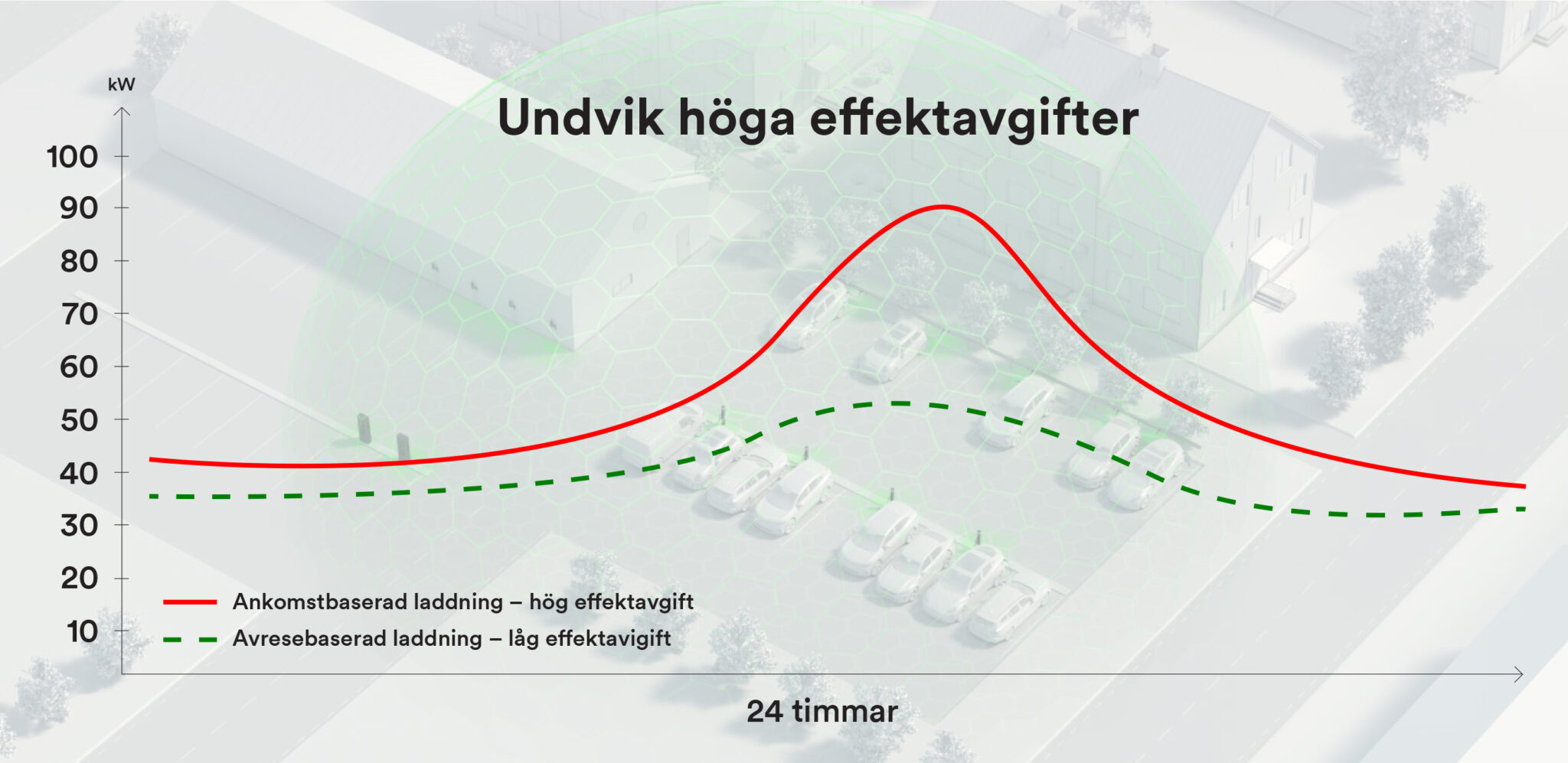
Med load balancing communicates the system with the charging stations and the other electricity consumption of the property, which means that the charging stations do not consume more electricity than the property can supply. By also choosing a departure-based and power-smart charging system, the available charging capacity is optimally distributed among departure times, the charging capacity of the cars and the desired charge, which means that power peaks are avoided. The combination of load balancing and Departure based charging allows the plant owner to reduce their electricity usage and thus avoid expensive power charges. In short, avoid high power charges with smart distribution of power.
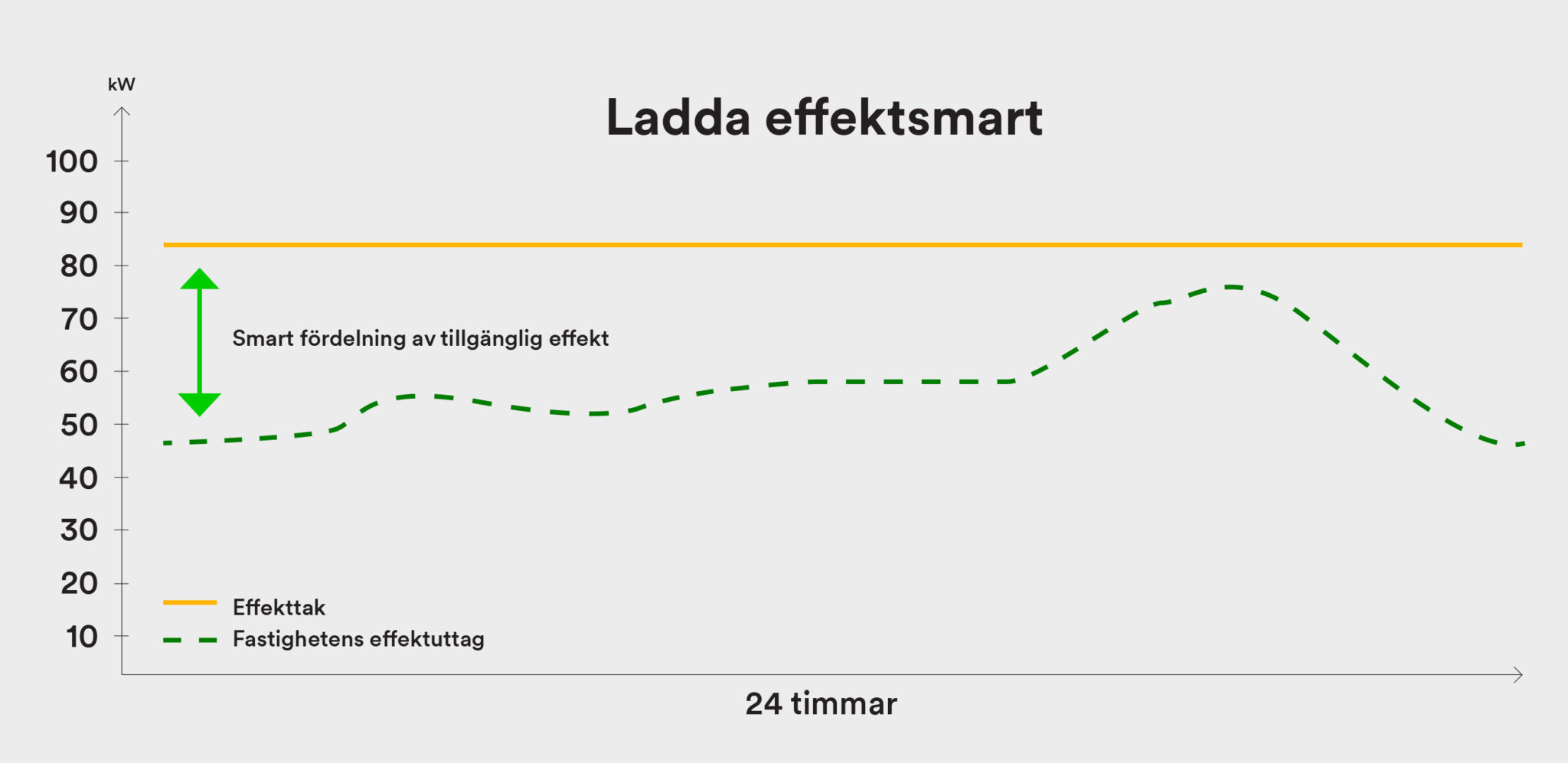
By installing ChargeNode's smart charging system, the power is automatically distributed over time according to when the respective car needs to go. It allows to reduce the cost of power and even out the load on the power grid. In a charging facility with 25 charging points, you often need to go up to 125A to cover the charging requirement when you do not have the ability to control the charge after departure time. ChargeNode's solution, where the charge is distributed over time, can supply the charging needs of a plant with only 63A. As a plant owner, you can save SEK 30,000 — 40,000 each year just by solving the demand for charging with a lower electricity subscription.
Read more about power smart charging control here
Charge Node Europe AB
Neongatan 4B
431 53 Molndal