The government's proposal for individual charging rights risks creating technical chaos in Sweden's BRFs. ChargeNode explains why collective end-to-end solutions are essential for safe, equitable and sustainable electrification.
.webp)
Government's legal advice referral “Increased opportunities for home charging of electric vehicles” has a laudable ambition: to accelerate electrification. But giving individual members of condominium associations and condominiums the right to install their own charging points outside a communal system is a risky strategy. The proposal overlooks the complex issues of systemic responsibility, long-term management and the technical security required for sustainable property management.
Sweden is facing a historic transformation of the vehicle fleet. We welcome the Government putting the issue of home charging on the agenda, but we have deep doubts about the method. Shifting the initiative from the property owner to the individual creates a fragmented technical management that in the long run becomes both more expensive and riskier for the association.
When we look towards Norway, the world's most mature electric car market, we see clear patterns. Where was introduced “laderetten” (the right to charge) already in 2017. However, Norwegian legislation requires the board to facilitate installation. The experience from there is unequivocal: the associations that allowed isolated, individual installations quickly suffered technical limitations and were later forced to tear out the equipment in favor of common, scalable systems.
In Norway, the success factor has not been the individual's right to “screw up his own box,” but the board's obligation to provide an infrastructure where everyone can connect on an equal footing. This is the lesson that Sweden should build on.
In Sweden, approximately 15—20 percent of housing associations are estimated to have invested in charging infrastructure. Experience shows that the electric car transition accelerates markedly where infrastructure is in place — especially when every parking space has access to a charging point.
Norway illustrates the potential: there, upwards of 85 per cent of condominium associations have invested in charging, contributing to the country's leading electric car penetration.
The conclusion is clear: the quickest way to accelerate the transition is to ensure that all residential car parks in apartment buildings have access to charging points.
One of the main shortcomings of the Swedish proposal concerns the limits of liability. When individual members are allowed to install their own charging points, questions immediately arise about the long-term system responsibility.
A garage with a variety of makes and disjointed installation types significantly complicates the possibility of conducting uniform service efforts. For a board of directors, this entails an increased legal burden, as it becomes almost impossible to guarantee that the entire facility complies with current safety standards and that insurance conditions are complied with in the event of an incident.
It is important to highlight that we already have a rigorous regulatory framework governing deployment. According to The Planning and Building Regulation (PBF) and the EU Energy Performance Directive (EPBD) There are clear requirements:
These requirements, along with government incentives such as The 'rechargeable' contribution, has successfully steered property owners towards taking a holistic approach. It is through planned, joint investments that we create a robust infrastructure -- not through reactive point-of-action efforts.
A key argument against individual installations is what we call the principle of fair use of capacity. Each property has a limited electrical power capacity. In a scenario where individual members install charging points without central control, the first few people risk using the entire available power space in the property.
As demand increases, the association is forced to undertake extensive and costly upgrades to the incoming electric service. This creates a deeply unfair economic distribution, with those members who join last to bear the burden of an infrastructure that should have been collectively planned from the get-go. Only a professionally managed end-to-end solution with dynamic load balancing can ensure a fair allocation of resources.
In order for electrification to be successful, order is required. We need systems that are maintainable, future-proofed for technical upgrades and that do not compromise the operational safety of the property.
We urge the government to focus instead on simplifying for property owners to invest in shared solutions. By strengthening incentives for collective expansion, we are ensuring that charging infrastructure becomes an asset for the property, rather than a technical and legal burden for the boards of the future.
Read more: The new bill on home charging: An opportunity — or a trap for BRF and the community?
Niklas Berg
Co-founder/Business Developer
niklas.berg@chargenode.eu

ChargeNode operates the charging service behind Nästa Energy Lab — one of Europe's largest V2G projects, launched today in Torslanda. With 160 charging points and a proprietary charging platform, ChargeNode enables a system where vehicles, buildings and batteries interact in real time. A partnership with Buddy Energy and Volvo Cars sets a new standard for large-scale V2G integration.
The government's proposal for individual charging rights risks creating technical chaos in Sweden's BRFs. ChargeNode explains why collective end-to-end solutions are essential for safe, equitable and sustainable electrification.
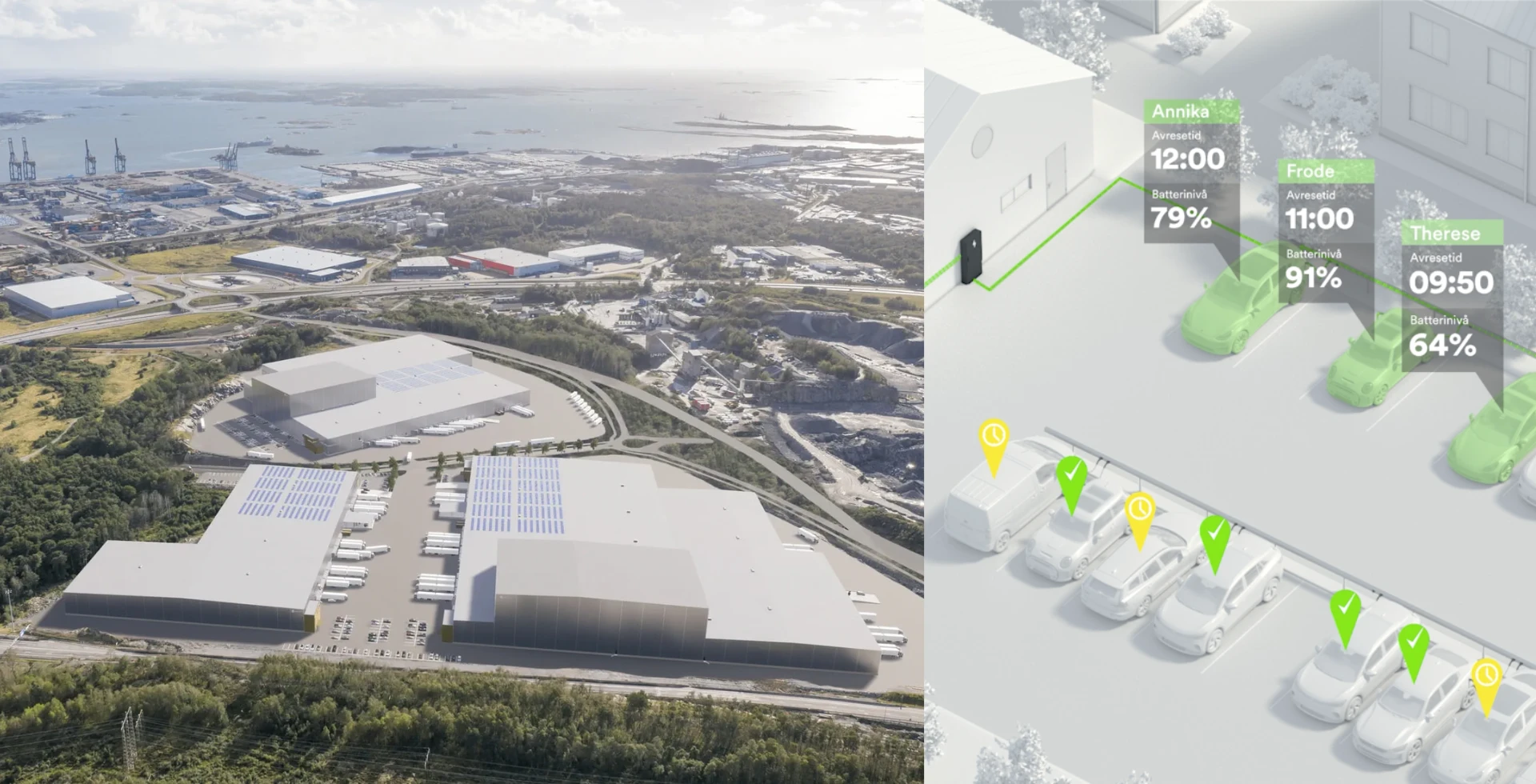
Buddy Energy and ChargeNode create an integrated energy solution in Halvorseng Logistics Park. Solar power, energy storage and smart charging make electrified logistics sustainable and profitable.
Charge Node Europe AB
Neongatan 4B
431 53 Molndal