Power tariffs will be introduced in 2027 - learn what they mean, how they affect your electricity bill and how smart steering can cut costs for households and properties.
Published: 2025-12-15
Last Updated: 2026-01-12
Power tariffs* are a pricing model that makes your grid charge dependent on how you use electricity, not just how much you consume. We explain it most simply this way: instead of just paying for the total amount of electricity (kWh) you use during the month, you also pay for how much you charge the grid at the same time (kW).
This means that your grid charge can be lower if you spread your electricity usage across the clock. However, if you use a lot of electricity at the same time - like when the electric car is charging, the oven is running and the washing machine is spinning - the cost will be higher.
All electricity grid companies in Sweden to introduce power tariffs no later than 1 January 2027 in accordance with the regulations of the Swedish Energy Market Inspectorate. The goal is to create a more even load on the power grid and reduce congestion when everyone is using electricity at the same time.
*Power tariffs or power charges are based on your maximum power consumption over a given period, usually measured in kilowatts (kW).
Your new electricity bill will consist of four parts:
Based on your subscribed power or fuse size
Covers measurement and administration costs
Pay per kilowatt-hour (kWh) as usual
New charge based on your maximum load (kW)
ChargeNode's great guide
on power tariffs 2027
Download our guide
Here we explain what impact tariffs mean, why they are introduced and how you can act smarter.
The guide includes:

The reason is simple: our society is electrifying at a rapid pace. As more and more people leave fossil fuels for electricity, the pressure on the energy system increases. This creates power peaks when many people use a lot of electricity at the same time, causing congestion in the power grid. For companies and municipalities, this can become an obstacle to growth because the capacity of the electricity grid is insufficient.
We are faced with two options to deal with this challenge. The first is to build out the electricity grid - something that both takes time and costs a lot of money. The second option, which power tariffs represent, is to use the existing electricity grid smarter by encouraging you to move and spread out your electricity use.
The basic principle behind power charges is fair: if you spread out your electricity use or shift it to times when fewer burden the grid, you pay less. However, if you use a lot of electricity at the same time as many others, you will pay more. In addition, this can lead to lower grid tariffs on average as it reduces the need for costly grid expansions.
Power fees are really nothing new for everyone. Larger customers such as industries have had power charges for many years. Now the development has reached a point where households also need to contribute to making electricity grids more efficient.
Impact tariffs give you the opportunity to influence your own cost. By spreading out your electricity usage and avoiding power peaks, you can both lower your bill and help reduce the strain on the grid. This is becoming increasingly important as society becomes electrified and more people choose electric cars.
For most people, the cost will be about the same level as today. Important to understand is that the electricity network companies are not making more money from power tariffs - it's about distributing costs differently. The goal is to keep down both society's spending on the electricity grid and your charges in the long run.
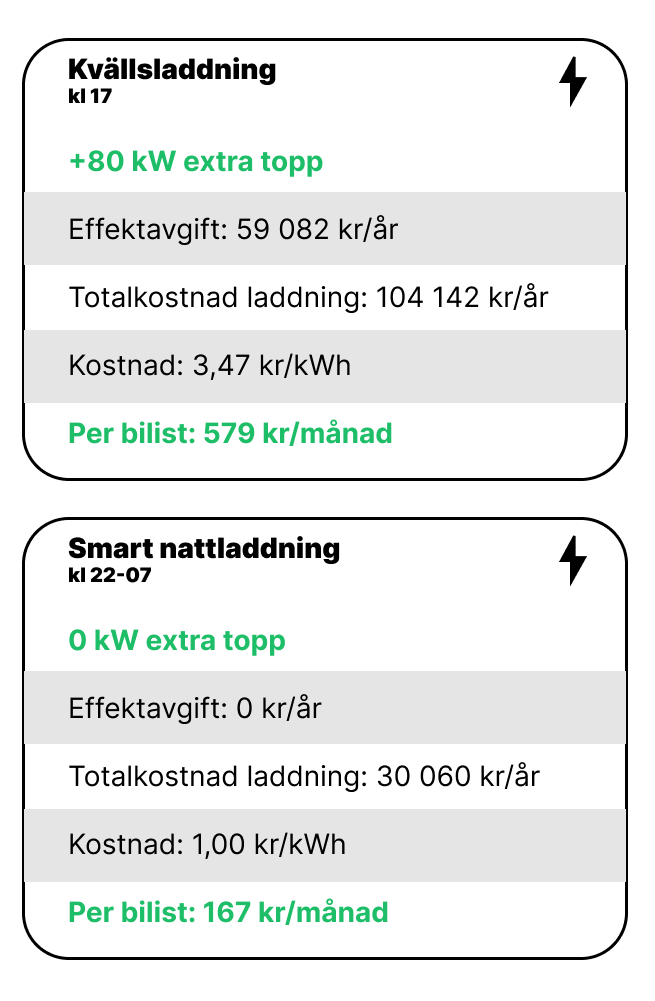
We look at a concrete example to show you how much difference smart charging can make. Here ChargeNode uses its own data and analyses a condominium association with 30 apartments where half of households own electric cars.
Electric cars are parked significantly longer than they actually need to be charged. In an average BRF, the car is stationary for about 14 hours, but the actual charge only takes around 2 hours. That means up to 12 hours of flexibility!
By controlling the charge at times with a lower electricity price and power charge, costs can be significantly reduced. The effect is spread out overnight, making the solution both cheaper and easier than investing in battery stocks or strengthening the power grid.
Savings: 74,082 SEK/year with smart night charging
Keep up to date with the latest in the industry — subscribe to our newsletter. It's an email. Once a month.
The difference between traditional charging and planned charging is obvious. Unplanned peak load occurs when several electric cars start simultaneously at full power, often when people are coming home from work. This coincides with dinner cooking and other household consumption. Just the combination of electric car charging, oven, washing machine and dryer creates a high power peak.
Smart charging on the other hand, distributes the charge over time with lower power. By lowering the charging power and scheduling the charge at night time, power peaks are greatly reduced.

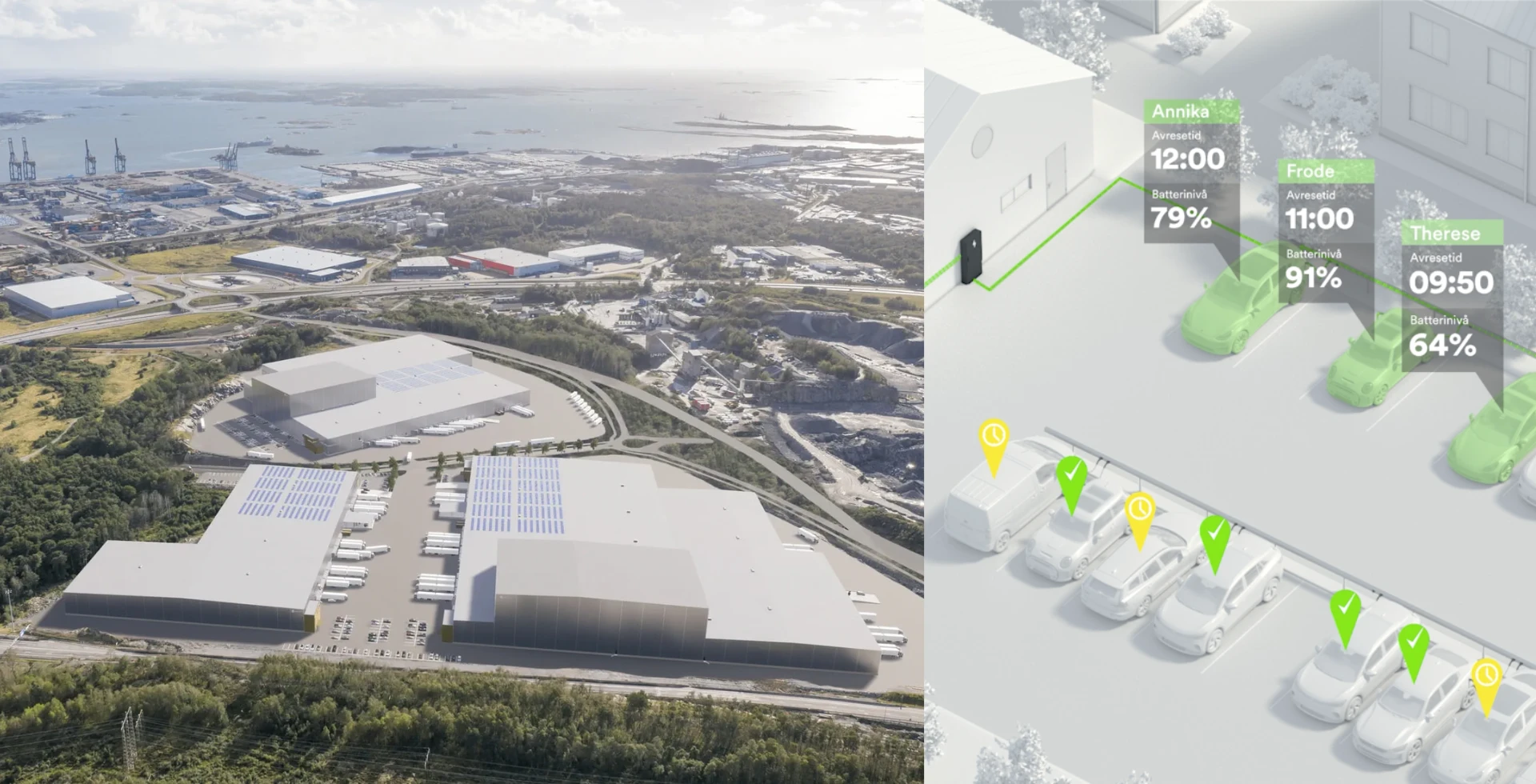
Buddy Energy and ChargeNode create an integrated energy solution in Halvorseng Logistics Park. Solar power, energy storage and smart charging make electrified logistics sustainable and profitable.
1. Find out how your power charge is designed
Each power grid company designs its tariff according to its own conditions, so the first step is to contact your power grid company.
2. Identify your power peaks
Log into the “My Pages” of your power grid company to see when your power peaks are happening. This is your map of where the savings are.
3. Use smart control for electric car charging
Charging points with load balancing automatically adjusts the charging power when other electricity consumers are active. By also stating Departure time the available charging power is optimally distributed according to the needs of each car.
4. Avoid running everything at the same time
Spread out your energy use over the day instead of lumping it together. Easy to avoid with a little planning.
5. Charge based on your grid company's power tariff
Med smart steering Electric vehicle charging can be optimised according to two crucial factors: Charge power smart based on the power tariff applied by your power grid company.
A condominium association with 15 electric cars could potentially Save over 70 000 SEK per year by implementing smart charging and load balancing. This means distributing the charge over time and with lower power, especially during nighttime hours when the power charge is often lower.
Energy is measured in kilowatt-hours (kWh) and indicates the amount of electricity used over a period. Power is measured in kilowatts (kW) and indicates how much energy is used per unit of time. Power tariffs focus on the power output, that is, how much electricity you use at the same time.
Power tariffs are based on your maximum electricity consumption at one time, not total consumption. By spreading out your electricity usage, you can lower your costs. For example, you can save by charging your electric car at night when many grid companies offer discounts.
You can prepare by finding out how your power charge is designed, identifying your power peaks, using smart control for electric car charging, avoid using multiple energy-consuming appliances at the same time and shift electricity use to off-peak hours, most often at night.
Power tariffs shall be introduced by all electricity network companies in Sweden by 1 January 2027 in accordance with the regulations of the Swedish Energy Market Inspectorate. Some companies have already implemented this pricing model.
Spring smart load balancing can significantly reduce power peaks by distributing the charge over time, which often saves the property owner expensive network tariffs without negatively affecting residents' charging needs.
Over 200,000 electric drivers use our app and charge in our charging systems.
Charge Node Europe AB
Neongatan 4B
431 53 Molndal